

Every business wants more traffic, leads, and customers from their website, but many Boise small business owners ask the same question: how often should I add new content? The short answer is: regularly enough to stay relevant and useful, but not so often that quality suffers. This article explains practical publishing cadences, what types of content matter most, and how to create a simple content strategy that fits a busy trades or home service operation.
Why publishing frequency matters
Search engines prefer fresh, relevant content because it signals an active, useful site. Publishing consistently helps with indexing, improves chances for ranking on targeted keywords, and keeps your local audience engaged. However, search engines also reward authority and usefulness, so a steady stream of low-value posts will not help. For small businesses, the goal is to publish high-quality content on a reliable schedule that supports local SEO and user needs.
Recommended cadences by content type
- Blog posts: 1 post per week is ideal for growth. If that is not realistic, aim for 2-4 posts per month. Each post should be 600-1,200 words and target a clear topic such as local how-to guides, project case studies, or neighborhood-focused pages. Consistency beats volume.
- Service pages: Create solid service pages once, then update them quarterly or whenever you change services, pricing, or offerings. Optimize each page for local search terms like “Boise plumber” or “Boise HVAC repair.”
- Landing pages for campaigns: Build these as needed for promotions, seasonal services, or Google Ads—typically one-off but refreshed for each campaign.
- Homepage and sitewide updates: Review every 3-6 months to keep messaging current. Small copy tweaks and adding new testimonials can improve conversions without a full redesign.
- FAQ and knowledge base: Add or refresh items monthly if customers ask new questions frequently. These pages can capture long-tail search traffic and reduce phone time.
Why different pages should be updated at different rates
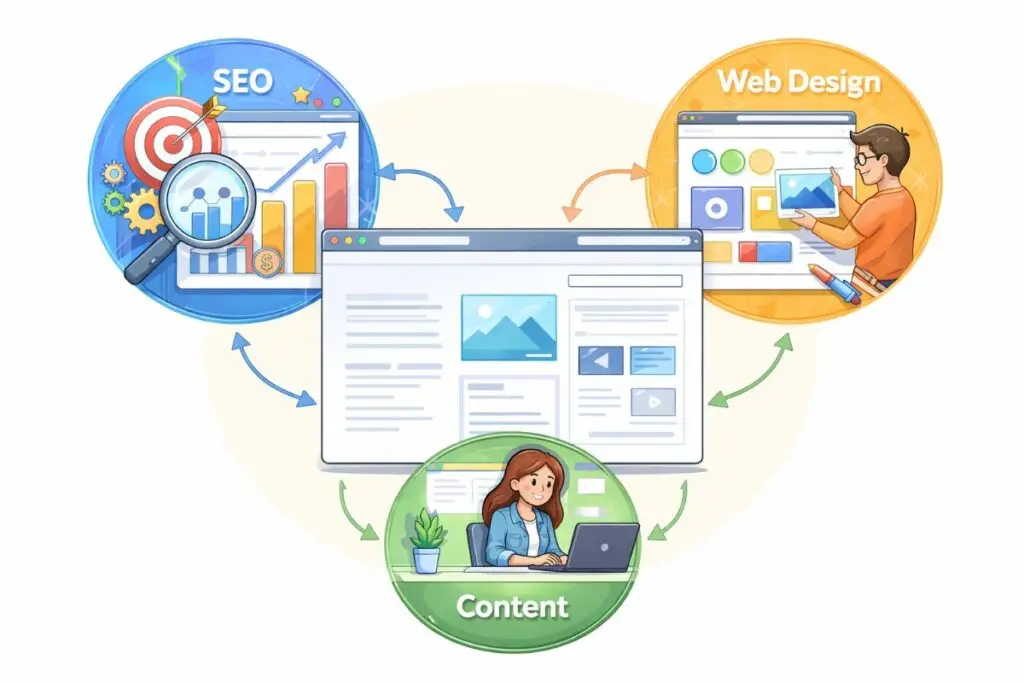
Blogs are discovery tools: they drive organic traffic and answer search intent. Service pages are conversion tools: they convince visitors to contact you. Landing pages are campaign-specific and need to be timely. Recognizing these roles helps prioritize effort so a small team can focus on the highest-return activities.
Quality over quantity: what to prioritize
- Answer real customer questions. Use call logs and common service issues to generate topics.
- Show projects with photos and specifics: before-and-after examples and clear results build trust.
- Localize content. Mention Boise neighborhoods, nearby cities, and common local problems—this improves local SEO and relevance.
- Optimize for search intent. Include clear headings, internal links, and a call to action on each page.
Build a simple content calendar
A content calendar removes guesswork. For a small operation, a one-page calendar is enough. Example:
- Monthly theme (e.g., winter prep for HVAC).
- Week 1: Publish blog on theme.
- Week 2: Post a project gallery or case study related to theme.
- Week 3: Update a service page or FAQ entry.
- Week 4: Promote posts via Google Business Profile and social media.
Use simple tools like a spreadsheet or a shared calendar to assign topics and publishing dates. Batch writing and scheduling can save time.
Measure what matters
Track metrics, not posting for the sake of posting. Useful KPIs include organic sessions, conversions (calls or form submissions), top landing pages, and keyword ranking improvements. Google Analytics and Google Search Console give most of this data. If weekly posts aren’t increasing leads after 3-6 months, evaluate topics, on-page SEO, and promotion strategy.
Tips for busy trades and home service businesses
- Repurpose content: turn a blog into a how-to video, checklist, or social post.
- Document jobs while on site: short write-ups and photos make fast, useful posts.
- Prioritize local case studies and testimonials—these build trust with nearby customers.
- Use templates for service pages and blog posts so formatting and SEO elements are consistent.
Common pitfalls to avoid
- Posting irregularly with large gaps—search engines and users prefer consistency.
- Publishing low-value filler content—quality matters more than frequency.
- Failing to promote new content—share on Google Business Profile, social media, and email to get initial traction.
Final practical schedule
If you are starting from scratch, try this low-effort, high-impact schedule:
- Month 1-3: One well-optimized blog post every two weeks + update top service page monthly.
- Month 4-6: Increase to one blog per week if you can maintain quality; continue monthly service page checks.
- Ongoing: Quarterly review of homepage and service pages; monthly tracking of KPIs and adjustments.
Consistency combined with local-focused, helpful content will yield steady improvements in organic traffic and customer inquiries.
Conclusion
There is no one-size-fits-all answer, but small businesses in Boise should aim for a consistent, sustainable publishing schedule. Prioritize quality, local relevance, and measurable results. A realistic cadence might be 2-4 blog posts per month with monthly service page reviews and quarterly sitewide checks. Over time, this approach improves search visibility and generates more leads.
Ready to build a content calendar that fits your schedule and gets results? Contact Boise WEB to discuss content, local SEO, and website updates. Get a free consultation and let our USA-based team help your small business grow online.