
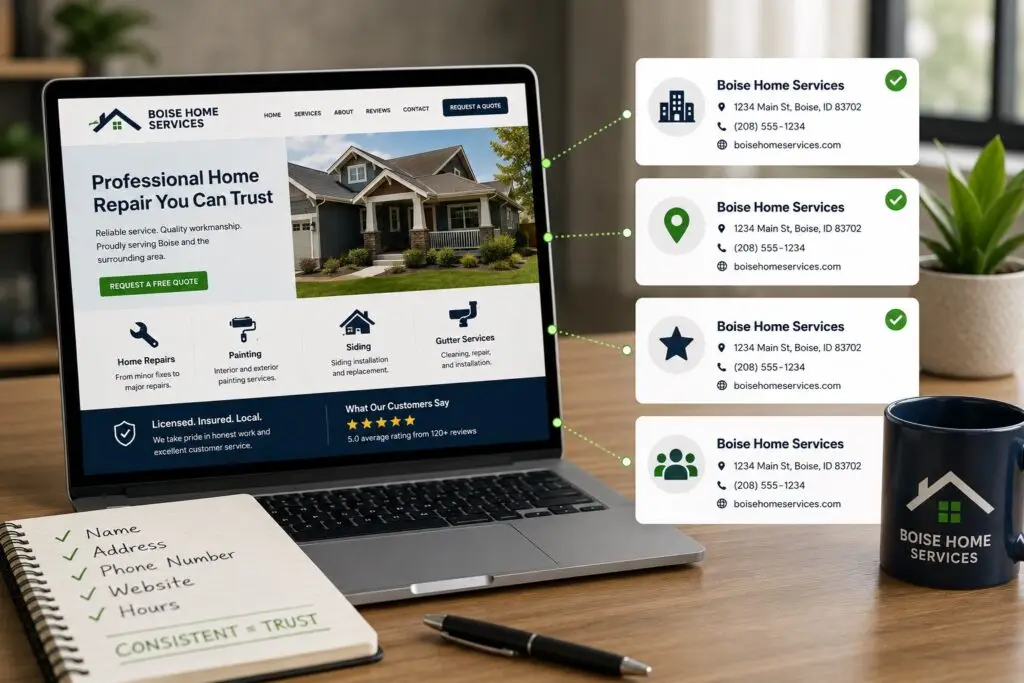
When potential customers search for a local contractor, plumber, or electrician, they expect accurate, up-to-date contact details. Search engines do, too. Inconsistent business information—different phone numbers, abbreviations, or address formats—creates confusion for Google and other directory services, which can reduce search visibility, harm map-pack ranking, and lower click-through and conversion rates.
Key terms and why they matter
- NAP: Name, Address, Phone. It is the core reference search engines use to tie a business to local search results.
- Citations: online mentions of your business information in directories and websites.
- Schema markup: structured data that helps search engines read and display your business details correctly in search results and rich snippets.
The real-world impact of inconsistent listings
- Lower local search rankings: Conflicting data makes it harder for search engines to determine which listing is authoritative, which can push you down in local results.
- Lost calls and visits: Customers who find the wrong phone number or an outdated address may choose a competitor instead.
- Reduced trust and damaged reputation: Inaccurate information undermines credibility and can reduce review volume and conversion rates.
- Map pack exclusion: Consistent, verified listings are more likely to appear in the highly valuable Google Map Pack.
Common causes of inconsistent information
Errors often appear after a move, phone number change, or rebranding. Other causes include multiple people submitting listings with slight variations, third-party data aggregators propagating wrong details, or legacy directory entries that were never corrected. Duplicate listings are especially damaging because they fragment reviews and signals.
How to audit and fix your business information
- Establish a single authoritative profile: Decide on the exact business name, address format, phone number, and hours you will use everywhere. This is your canonical NAP.
- Audit current listings: Use tools like Google Business Profile (formerly Google My Business), Moz Local, BrightLocal, or manual checks to list where your business appears. Note variations and duplicates.
- Claim and verify key listings: Claim your Google Business Profile, Bing Places, Yelp, Facebook, and major industry-specific directories. Verification increases trust and gives you control.
- Correct duplicates and errors: Merge or remove duplicate listings, and correct inconsistent formats (e.g., “St.” vs “Street”). Reach out to directory owners or use management tools to update multiple listings at once.
- Add structured data to your website: Implement LocalBusiness schema markup so search engines can parse your NAP, hours, services, and service areas easily.
- Standardize citations: Ensure industry directories and local aggregators (data providers) have the same canonical details to prevent future drift.
- Monitor and maintain: Schedule quarterly audits and set up alerts for changes. Reputation management and review responses help keep details accurate and updated.
Tools and tactics that help
Third-party platforms like BrightLocal, Whitespark, Moz Local, and Yext simplify citation management and duplicate suppression. Google Business Profile remains the most influential single listing; keep it complete with photos, services, categories, and regular posts. Use review management to consolidate social proof on your authoritative listing rather than spread it thin across duplicates.
How this ties into broader local SEO
Consistent business information supports link building, local content, and on-site optimization. When your NAP is stable and your Google Business Profile is healthy, search engines are more likely to reward your site with better local rankings, improved map placement, and more visibility for service-area queries. For trades and home services, appearing in the map pack often leads directly to phone calls and booking requests—high-value conversions for your business.
Practical timeline and expectations
Fixing inaccurate listings can show measurable improvements in weeks, but full recovery and ranking gains often take months. Duplicate removal and aggregator corrections may require persistent follow-ups. Regular maintenance—quarterly or semiannual checks—prevents regressions and preserves search visibility.
Why working with a local web partner helps
Small business owners are busy running operations. A partner who understands local SEO and citation management saves time and avoids costly errors. Boise WEB specializes in helping trades and home-service businesses get found online. We combine website optimization, Google Business Profile setup, schema markup, and citation cleanup to deliver reliable, measurable results.
Conclusion
Consistent business information is a foundational element of local SEO and online reputation. It directly influences search rankings, map-pack visibility, customer trust, and lead generation. Regular audits, verified listings, structured data, and a plan for ongoing maintenance turn inconsistent citations into a competitive advantage.
If your listings need a checkup, Boise WEB can audit your citations, help clean up duplicates, implement schema markup, and manage your Google Business Profile. We specialize in affordable web design and local SEO for trades and home-service businesses.
Contact Boise WEB today by phone, text, or email to schedule an audit and start getting more local customers.